Will You Let Me In? is an activist performance created and presented specifically for Saint Saviour’s Anglican Church in Riga as part of the festival Starptelpa. The work takes place in a church not as a neutral architectural setting, but as a charged symbolic field: a place historically associated with salvation, moral judgement, ritual belonging, and the promise of Heaven. Within this context, the performance asks who is imagined as “good enough” to enter sacred space, who is allowed to belong, and whose body is still treated as a theological, social, or political problem.
The performance is rooted in the lived tension between queer existence and religious narratives that have often been used to discipline, exclude, or condemn LGBTQ+ people. Although the artist does not approach the church from a Christian position, the language of sin, purity, salvation, and “proper” life remains socially present. In Latvia, where religious authorities have repeatedly positioned themselves against queer rights and same-sex partnerships, the church becomes more than a religious site: it becomes a structure of public meaning, power, and access. At the same time, Saint Saviour’s Anglican Church in Riga carries another layer of significance: it is officially connected to the Church of England Diocese in Europe and identifies itself as the only congregation in Latvia belonging to Inclusive Church, a network that affirms people regardless of gender, gender identity, or sexuality. (A Church Near You) This makes the performance possible within a complex space of contradiction, memory, and potential care.
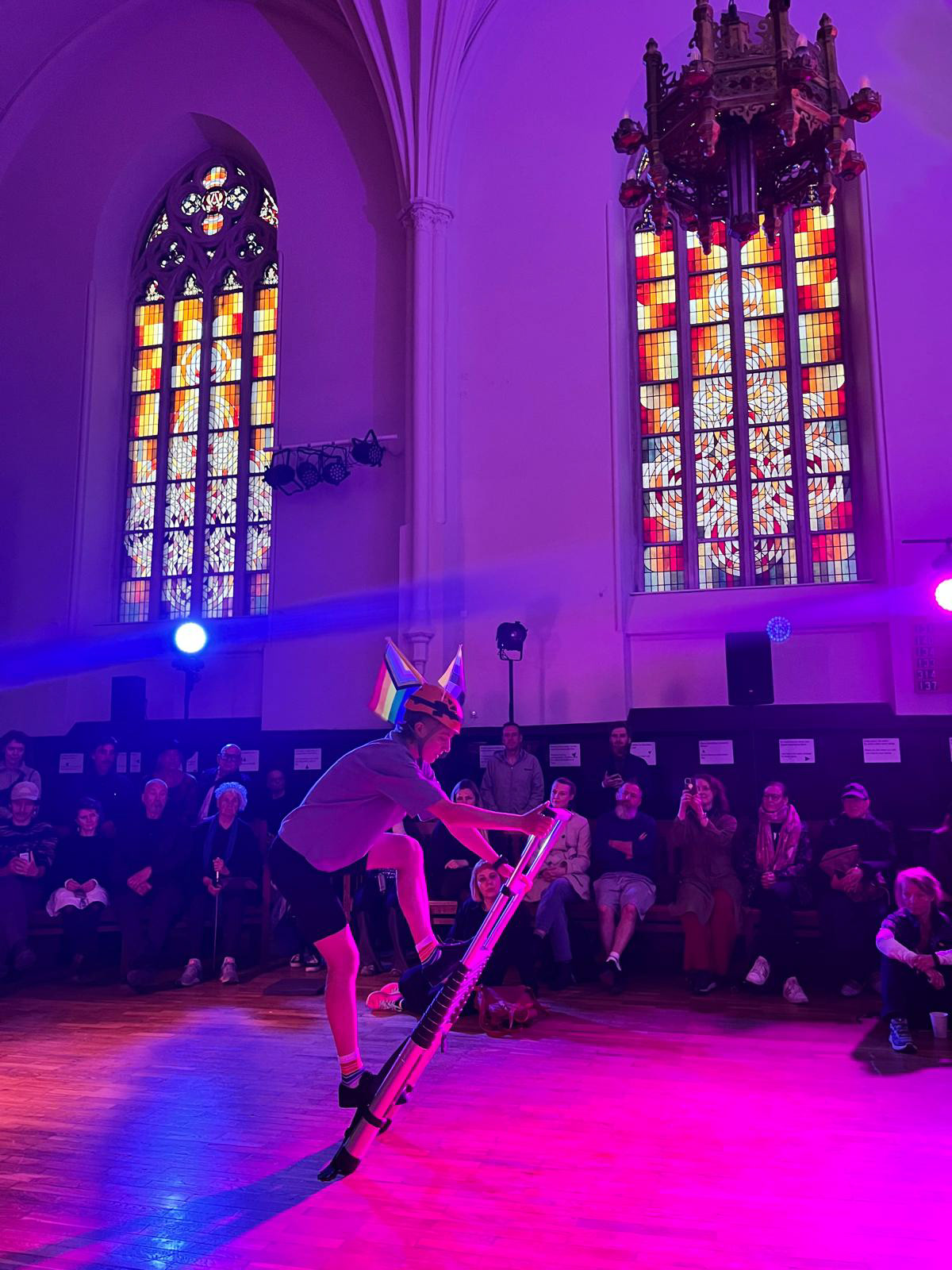
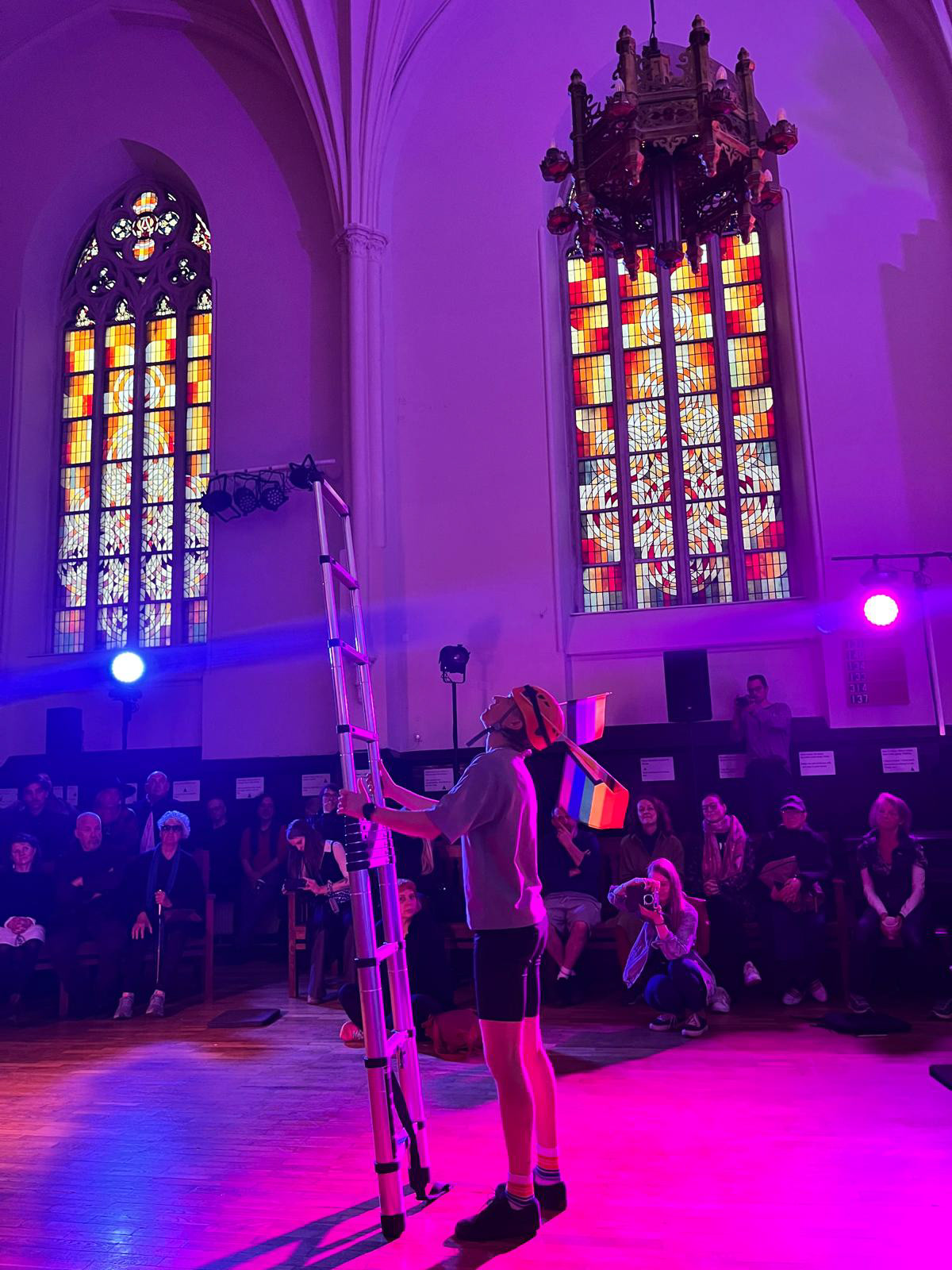
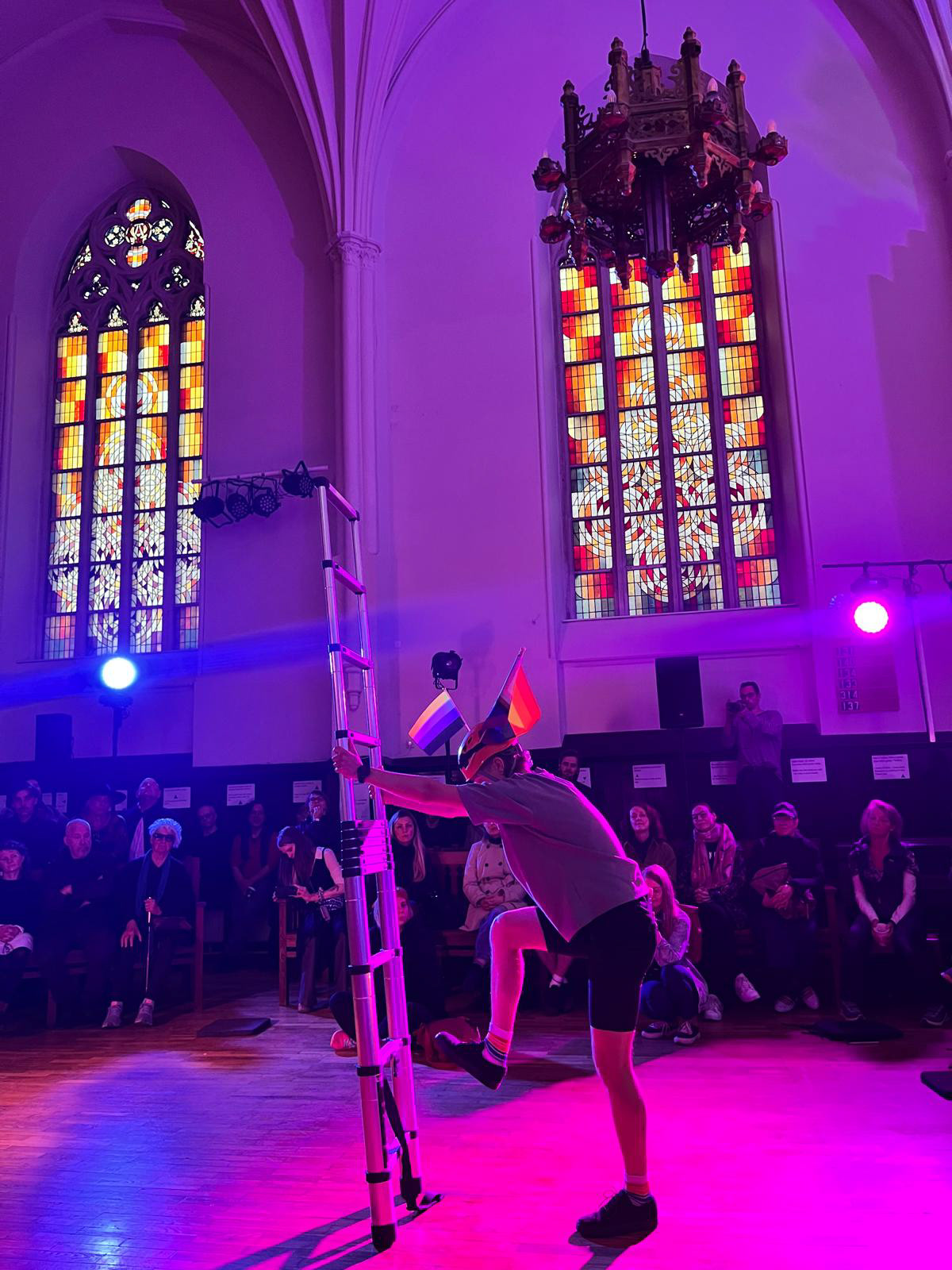
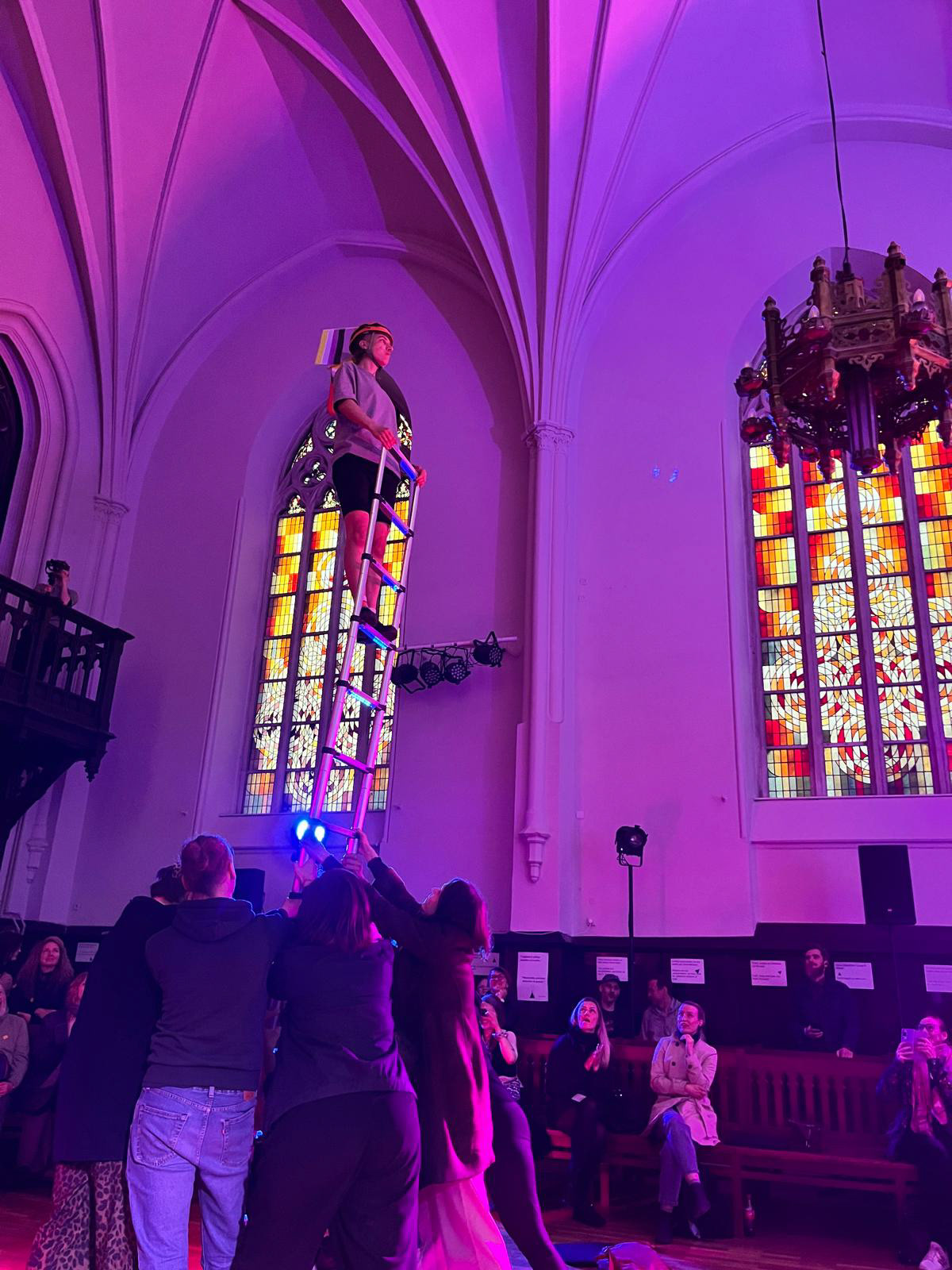
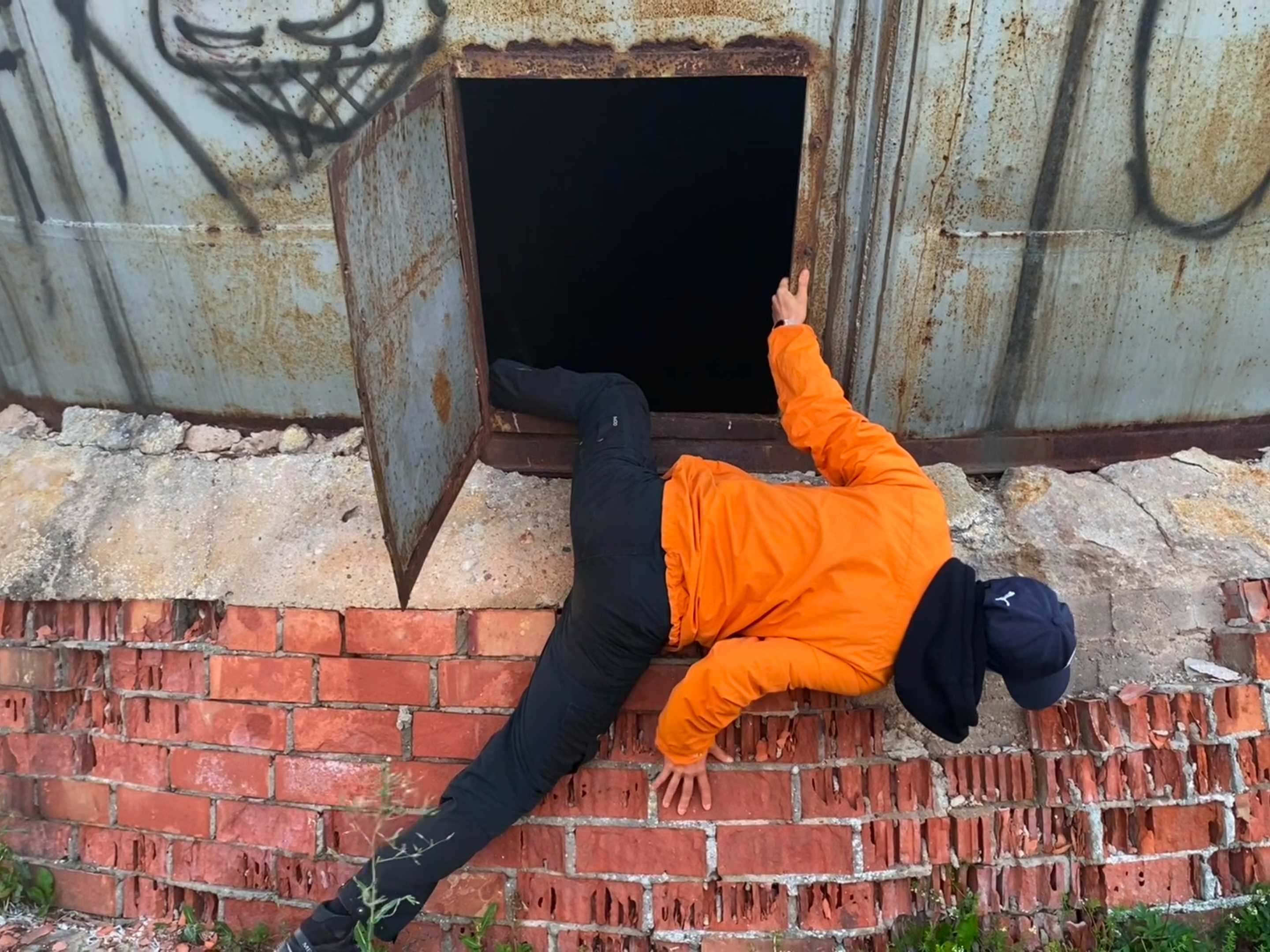
The action unfolds through a simple but unstable task. The artist brings a telescopic ladder into the church and begins to extend it section by section, attempting to climb upward — toward “Heaven”, or toward the place symbolically reserved for the righteous, the worthy, the saved. Yet the ladder cannot remain stable when held alone. Each attempt to ascend leads to collapse: the body loses balance, the ladder falls, metal hits the floor, and the church fills with sound. The repeated falling is not only physical failure, but a performative image of queer precariousness: the exhausting attempt to rise within a system that does not structurally support you.
Here the work enters dialogue with Judith Butler’s thinking on performativity and social recognition: bodies become legible through repeated norms, gestures, and roles, yet queer and non-binary bodies often interrupt the scripts through which “proper” gender, morality, and belonging are recognised. The climb becomes a repeated attempt to enter a normative order that refuses to hold. Michel Foucault’s analysis of institutions, discipline, and the regulation of bodies is also present: the church is approached not simply as belief, but as a historical apparatus through which bodies have been named, ordered, judged, and made obedient. The ladder therefore becomes both tool and metaphor — a fragile vertical system that promises ascent while constantly producing collapse.
The work also resonates with Sara Ahmed’s writing on orientation: how bodies are directed toward certain futures, objects, spaces, and forms of life, while others are made to feel out of place. In this performance, the queer body is oriented upward, toward a symbolic promise that has rarely been offered freely. Yet the path is crooked, unstable, and dependent on others. Jack Halberstam’s “queer art of failure” becomes relevant here as well: falling is not treated only as defeat, but as a method of revealing the violence of success narratives. To fail repeatedly in front of others is to expose the conditions that make “success” possible for some bodies and dangerous for others.
Sound is central to the work. The metallic crashes, vibrations, echoes, and pauses transform the church into a resonating body. In relation to the festival’s theme Sonic Vibrations, the performance understands sound as evidence: every fall leaves an acoustic trace of effort, exclusion, risk, and persistence. The vibration is not decorative; it is the material consequence of a body trying to climb without support.
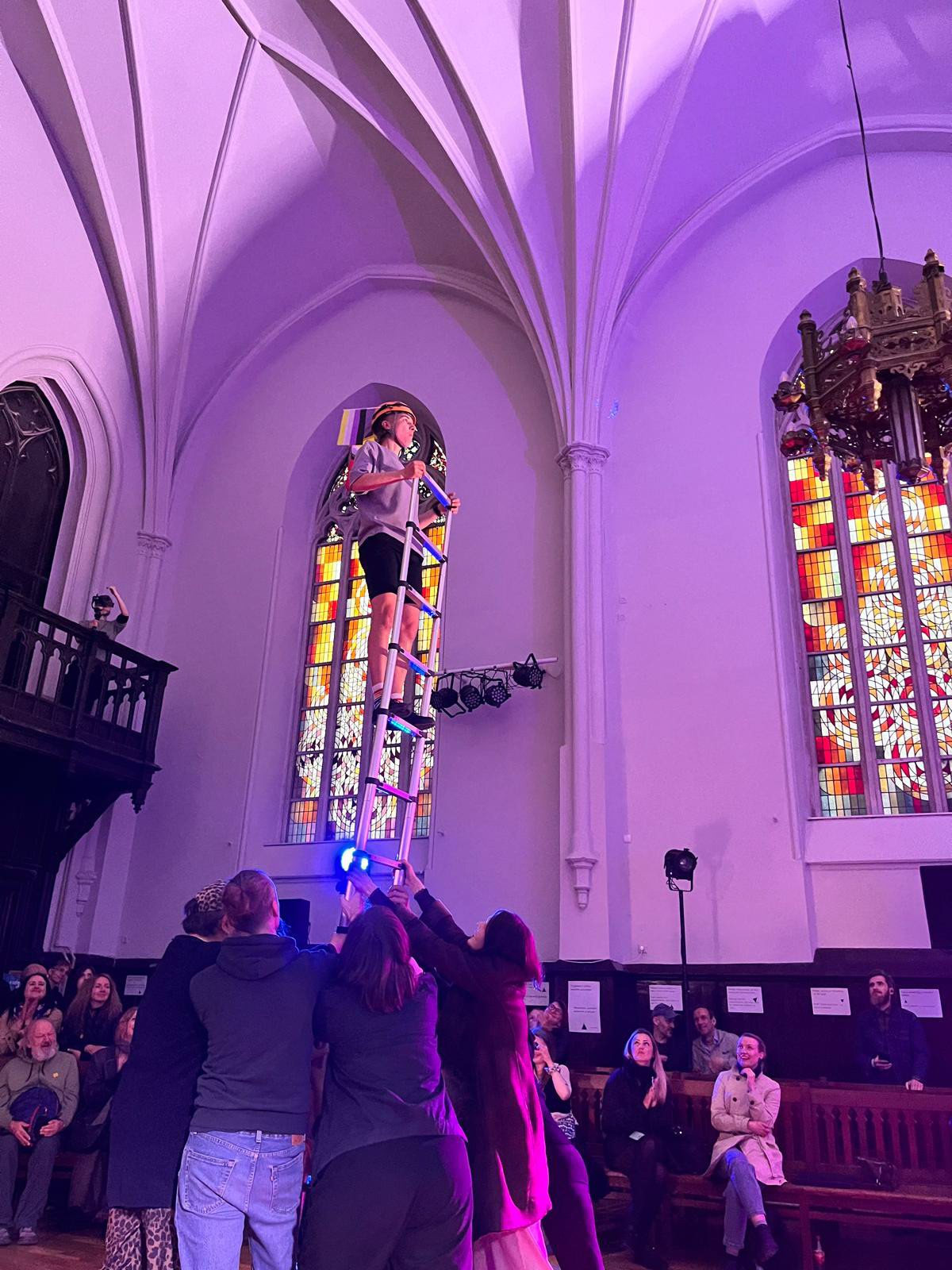
A crucial shift occurs when the artist stops behind the ladder and looks toward the audience. The performance silently asks whether anyone will understand that help is possible. For a long time, no one intervenes. Some hesitate, some watch, some may assume that the fall is simply part of the work. Eventually, a queer person in the audience asks, “Do you need help?” Only then does the piece move from individual endurance into collective action. People come forward, hold the ladder, and the artist is finally able to climb to the top.
This ending does not offer a simple resolution. It does not claim that institutions become inclusive because one body is helped upward. Rather, it insists that access is not abstract. Inclusion is physical, social, and collective. Someone has to notice instability. Someone has to ask. Someone has to hold the structure differently.
In this sense, Will You Let Me In? is an activist work not because it delivers a slogan, but because it stages the politics of support in real time. It asks what queer rights mean beyond legal language: who is willing to intervene, to risk awkwardness, to step forward, to hold weight? The performance turns “Heaven” into a question of infrastructure. Not who deserves to enter, but who is being held when they try.

You may also like

Back to Top